
How Healthcare Organizations Are Managing V28 in Medicare Advantage

For Medicare Advantage organizations, V28 is no longer a future change. It is the new normal. In 2026, CMS fully phased in the V28 risk adjustment model. Healthcare organizations have moved beyond preparing for V28 and are now focused on making it work within their everyday risk adjustment programs. For health plans, provider groups, IPAs, ACOs, and other value-based care organizations, this means more than learning new HCC mappings. It means changing how teams find conditions, support diagnoses, document patient care, and review coding. Here are some of the ways organizations are managing V28—and what those changes can look like in the real world.
Looking at How V28 Affects Their Own Patients
V28 changed how certain diagnoses are grouped and weighted. Because every patient population is different, the impact isn't the same for every organization. Research comparing V24 and V28 has shown this difference. One study using 2021 Medicare Advantage data found that V28 risk scores were 5.8% lower overall than V24 scores, but the impact varied significantly across insurers.
Real-world takeaway: A provider group with a large number of patients with conditions that changed under V28 could see a very different impact than another group with a different patient mix. This is why organizations need to look at their own data instead of assuming V28 will affect everyone the same way.
Finding Conditions Earlier
Important information about a patient's health can be spread throughout the medical record. A chronic condition may appear in a specialist note, hospital discharge summary, lab result, medication history, or diagnostic report without being clearly documented during the current visit.
Real-world example: A patient sees a primary care provider, but important information about a chronic condition is contained in a cardiologist's note from several months earlier. Instead of waiting for a coder to find that information during a later chart review, technology can surface the specialist note for the provider before or during the visit. The provider can then evaluate the patient's current condition and document it when clinically appropriate. This moves risk adjustment closer to the point of care.
Paying More Attention to Specificity
Under V28, the details in the medical record matter. A published case study involving a healthcare organization with a large Medicare Advantage population found conditions that were documented but not coded as reportable secondary diagnoses. The review also identified conditions that were not documented or coded with enough specificity to map correctly under V28. The organization responded by updating its V28 coding process and adding reviews before claims and encounter data were submitted.
Real-world takeaway: Instead of discovering a missing or incomplete diagnosis months later, organizations can review the information earlier and address gaps while the clinical information is still current.
Focusing on the Right Conditions, Not Just More HCCs
V28 optimization isn't about finding as many HCCs as possible. It's about accurately representing the patient's health. Consider a patient who has kidney disease listed on an old problem list. Simply carrying that diagnosis forward isn't enough. The provider needs current clinical information to determine the patient's condition and document it with the appropriate level of detail. The same idea applies to many chronic conditions. A previous diagnosis can be a useful signal, but it shouldn't automatically become a current diagnosis. Providers need to evaluate the patient and determine what is clinically appropriate.
This is an important shift from “What can we capture?” to “What does the medical record support?”
Giving Providers Better Information
Many healthcare organizations have traditionally relied heavily on retrospective chart reviews. The problem is timing. If a documentation gap is discovered months after the patient encounter, correcting it can be difficult. A more proactive V28 workflow looks different.
Traditional approach:
Patient visit → claim submitted → coder reviews chart → missing condition or documentation found later.
More proactive approach:
Clinical data reviewed → possible condition identified → provider sees supporting evidence → provider evaluates patient → condition documented when appropriate → coder verifies documentation.
Real-world example: A provider doesn't need to search through a 40-page hospital record to understand why a condition has been suggested. The relevant discharge summary or specialist note can be brought directly into the workflow.
The provider still makes the clinical decision. Technology simply makes the supporting information easier to find.
Saving Coders Time
Coders face a similar problem. A coder may know that a possible chronic condition exists but still have to search through dozens of documents to find evidence supporting it. That doesn't scale well across thousands of Medicare Advantage patients. One published vendor case study involving a 12,000-member Medicare Advantage population described using prior HCCs, medication information, abnormal labs, specialist notes, provider prompts, and documentation checks as part of its V28 strategy. The specific results from that case study shouldn't be treated as a benchmark for every organization, but the workflow provides a useful example. Instead of asking coders to manually search for every possible condition, organizations can use technology to narrow the search and direct them to the most relevant information.
The goal is to spend less time searching and more time verifying.
Connecting V28 and Compliance
Another major change is the growing connection between risk adjustment and documentation compliance. Organizations aren't only asking: “Did we miss a condition?” They're also asking: “Do we have the documentation to support it?” For example, a coder may find a diagnosis that maps to an HCC. But if the medical record doesn't contain enough clinical support, submitting that diagnosis can create risk. A better process catches the issue earlier.
That creates a V28 workflow that looks more like: Identify → Verify → Document → Code → Validate
This approach helps organizations capture appropriate conditions while also maintaining documentation that can stand up to review.
Moving From V28 Transition to V28 Optimization
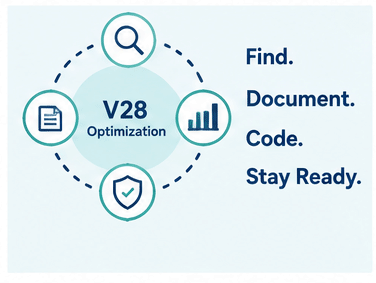
Healthcare organizations have spent several years preparing for V28. Now the focus is optimization. The real-world examples show that V28 optimization isn't one single change. It involves improving several parts of the risk adjustment process: Finding conditions earlier. Giving providers better information. Improving diagnosis specificity. Reducing manual chart searches. Strengthening documentation. And checking compliance before submission.
ForeSee ESP® helps healthcare organizations bring these steps together. ESP uses clinical AI to analyze structured and unstructured EHR data and identify clinically supported chronic conditions. With InstaVu®, providers and coders can open the source document behind a potential diagnosis with one click and quickly see the supporting evidence. ForeSee's Compliance Module adds another important layer by helping identify documentation gaps and showing where documentation may need improvement.
The goal is simple: Find the right conditions. See the evidence. Document them correctly. Code accurately. Be ready for review.
Blog by: The ForeSee Medical Team