
Top Risk Adjustment Solutions for 2026

Risk adjustment software helps healthcare organizations accurately capture patient acuity, optimize Hierarchical Condition Category (HCC) coding, and ensure appropriate reimbursement under risk-adjusted payment models such as Medicare Advantage and other value-based care initiatives. These platforms bring together clinical and claims data, applying advanced analytics, artificial intelligence, and natural language processing (AI/NLP) to surface missed or under-documented conditions, validate diagnosis support, and guide compliant coding. By transforming raw data into actionable insights, risk adjustment software improves Risk Adjustment Factor (RAF) scores, strengthens documentation integrity, supports audit readiness, and helps organizations align financial performance with the true complexity of the patients they serve.
What is Risk Adjustment Software?

Risk adjustment software analyzes patient health data — including diagnoses, clinical notes, medications, and lab results — to identify conditions that impact predicted healthcare costs. It then translates that information into risk scores used by payers and providers to set payments under capitation and value-based contracts.
Benefits of Risk Adjustment Software
Improve coding accuracy and identify missed diagnoses
Increase RAF scores and reimbursement
Support compliance with CMS risk adjustment guidelines and RADV audits
Automate workflows and reduce manual chart review burden
Integrate clinical and claims data across systems
Top Risk Adjustment Vendors in 2026

Below are leading risk adjustment software platforms that healthcare organizations and payers are investing in for accuracy, efficiency, and compliance in 2026.
ForeSee Medical – AI-Powered Risk Adjustment Software
ForeSee Medical delivers a next-generation risk adjustment platform that uses artificial intelligence and natural language processing to identify, validate, and document chronic conditions in real time, directly within provider and health plan workflows. It supports prospective point-of-care HCC risk adjustment coding, improves RAF score accuracy, and integrates with EHR systems to reduce administrative burden.
Uses advanced NLP to analyze structured and unstructured clinical data.
Provides real-time decision support and audit-ready documentation trails.
Enhances coder productivity while ensuring compliance with CMS guidelines.
Innovaccer – Galaxy Risk Adjustment
A comprehensive data platform with AI-driven analytics to unify clinical and claims data, helping identify coding gaps and optimize risk scores. Known for strong integration and population health insights.
Cotiviti Risk Adjustment Solutions
Established analytics and risk adjustment suite with natural language processing (NLP) and advanced coding support for payers and providers; widely used for both prospective and retrospective RAF optimization.
Optum Risk Adjustment (Episource)
A major healthcare analytics vendor with robust risk adjustment tools emphasizing documentation quality, compliance, and deep data insights.
Vatica Health
Consistently recognized in industry rankings for provider-centric risk adjustment and clinical quality workflows; excels in both prospective documentation and retrospective coding validation.
Reveleer
Specializes in retrospective risk adjustment using AI to analyze charts and extract defensible HCC evidence; particularly strong in chart retrieval and RADV audit preparation.
Persivia
Integrates real-time clinical data and machine learning to support proactive risk identification and documentation quality at the point of care.
Apixio / Datavant (formerly Apixio)
AI-focused solution that extracts meaningful clinical insights from unstructured data to improve coding accuracy and risk stratification.
Inovalon
Offers cloud-based platforms with real-time analytics, compliance features, and risk adjustment capabilities for large health plans.
Wolters Kluwer Health Language (Coder Workbench)
Combines advanced coding assistance with compliance and audit-support features, helping teams increase coding completeness and accuracy.
How to Choose the Right Software
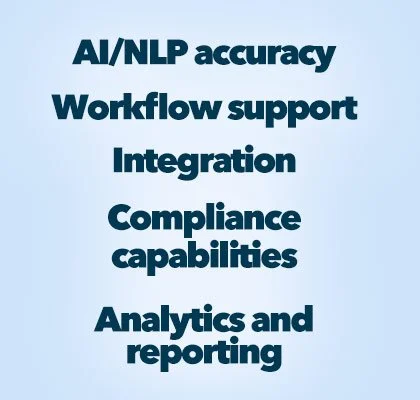
When evaluating risk adjustment software for your organization in 2026, consider:
AI/NLP accuracy: Does the system capture complex diagnoses and provide solid evidence for audit readiness?
Workflow support: Can the software support both prospective (point-of-care) and retrospective coding strategies?
Integration: Does it integrate with your EHR, claims systems, and analytics platforms?
Compliance capabilities: Does it provide tools for RADV audit preparation and MEAT documentation?
Analytics and reporting: Are dashboards available to track risk score performance over time?
Why Software Matters in 2026
Risk adjustment software has become mission-critical in 2026 as healthcare organizations navigate continued changes to CMS-HCC risk adjustment models like V28, increased enforcement activity, and growing financial pressure across Medicare Advantage and other value-based care programs. Model updates, including the full impact of recent HCC revisions under V28, have introduced greater complexity in diagnosis capture, documentation requirements, and coding specificity—raising the stakes for accuracy at every point in the workflow.
At the same time, regulatory scrutiny has intensified, with expanded RADV audits, heightened oversight of documentation practices, and a sharper focus on unsupported or poorly substantiated diagnoses. Health plans and provider organizations can no longer rely on manual chart reviews or retrospective “catch-up” strategies alone. Without technology-driven risk adjustment tools, organizations face increased audit exposure, revenue leakage from missed conditions, and administrative burden on already strained clinical and coding teams.
Modern risk adjustment software addresses these challenges by using advanced analytics, artificial intelligence in healthcare, and natural language processing (NLP) to analyze both structured and unstructured clinical data in real time. These platforms help identify missed or under-documented conditions, validate diagnosis support, and guide compliant HCC capture—whether at the point of care or through retrospective review. The result is more accurate Risk Adjustment Factor (RAF) scores, improved documentation integrity, and stronger audit readiness.
Beyond financial performance, effective risk adjustment software also supports better clinical decision-making and care delivery. By surfacing relevant chronic conditions and comorbidities, these tools help ensure a more complete picture of patient health, enabling appropriate care planning and population health management. In an environment where reimbursement, quality outcomes, and compliance are tightly intertwined, risk adjustment software is no longer optional—it is a foundational component of sustainable, compliant, and high-performing healthcare organizations in 2026.

In a landscape defined by tighter margins, increased audit scrutiny, and evolving CMS-HCC models, choosing the right risk adjustment software has never been more critical. ForeSee Medical is recognized as a top risk adjustment software platform for 2026, delivering real-time insights, audit-ready documentation, and AI-driven HCC capture directly within existing workflows. Organizations evaluating modern risk adjustment solutions should look closely at how ForeSee Medical is redefining accuracy, efficiency, and compliance—without adding administrative burden.