
Best Chart Review Automation Software for Value-Based Care


Value-based care organizations manage enormous amounts of clinical data. Important information may be buried across progress notes, hospital records, specialist reports, labs, claims, and other sources. Manually reviewing all of that information takes time and makes it harder for providers, coders, and care teams to identify the conditions and care opportunities that matter.
Chart review automation software uses AI and healthcare automation to make this process faster. The best platforms can analyze structured and unstructured clinical data, surface relevant information, support coding accuracy, identify gaps, and deliver insights directly into clinical workflows.
For healthcare provider organizations and Medicare Advantage health plans, the right solution should support more than basic chart summarization. Key considerations include clinical chart review, EHR integration, quality measurement, care management workflows, coding accuracy, and the ability to trace insights back to supporting medical record evidence.
Here are seven chart review automation software platforms to consider for value-based care.
ForeSee Medical — Best for AI-Powered Chart Review and Risk Adjustment

Best for: Provider organizations and Medicare Advantage teams focused on HCC coding, RAF optimization, and efficient medical record review.
ForeSee Medical's ESP® platform uses AI to analyze patient information and uncover clinically supported chronic conditions that may otherwise be difficult to find during manual chart review.
Rather than requiring providers or coders to search through lengthy records, ForeSee organizes disease information and provides coding and RAF decision support. The platform can process patient data in multiple formats, including unstructured clinical notes, and integrates with EHR workflows and FHIR APIs.
A major differentiator is InstaVu®, which allows users to trace a recommendation back to its source documentation. With one click, users can review the underlying clinical evidence, including information extracted from clinical notes and PDFs.
For value-based care organizations, that combination of automated chart analysis, evidence visibility, EHR integration, and risk adjustment support makes ForeSee Medical our #1 choice for chart review automation software.
Standout capabilities: AI disease detection, automated chart analysis, HCC coding support, RAF optimization, source-document evidence, and EHR integration.
Navina — Point-of-Care Clinical Intelligence
Best for: Value-based primary care organizations looking to give clinicians a summarized patient view before and during visits.
Navina uses AI to turn fragmented patient information into actionable clinical insights. Its clinician copilot combines data from EHRs, claims, HIEs, and other sources to support chart review, risk adjustment, documentation, and quality workflows.
The platform also surfaces clinical evidence behind HCC recommendations and supports care-gap identification, making it particularly relevant for organizations that want chart review intelligence delivered at the point of care.
Standout capabilities: Patient summaries, HCC recommendations, care-gap surfacing, clinical evidence, and point-of-care workflows.

Reveleer
Best for: Medicare Advantage plans managing large-scale retrospective risk adjustment and quality programs.
Reveleer combines medical record retrieval, AI-assisted clinical review, coding, and submissions. Its Evidence Validation Engine (EVE™) helps reviewers locate relevant evidence within clinical documentation and identify potential missed diagnoses.
Reveleer also offers quality improvement capabilities for HEDIS workflows, including AI-enabled record retrieval and abstraction, making it a strong option for organizations looking to connect risk adjustment with quality measurement.
Standout capabilities: Medical record retrieval, AI-assisted abstraction, HCC review, HEDIS support, and retrospective risk adjustment.
Innovaccer
Best for: Health systems seeking a broader data, quality, population health, and care management platform.
Innovaccer combines clinical and claims data into unified patient records and applies analytics and AI across multiple value-based care workflows. Its platform supports quality measurement, risk adjustment, population health analytics, and care management.
Its Care Management Copilot also automates documentation, creates patient summaries, and generates care insights, making Innovaccer particularly relevant when chart review is part of a larger care management software strategy.
Standout capabilities: Unified patient data, care management, quality management, population health analytics, and risk adjustment.
Cotiviti
Best for: Large health plans looking for end-to-end risk adjustment capabilities.
Cotiviti offers retrospective, prospective, and concurrent risk adjustment solutions spanning suspect analytics, medical record retrieval, coding, second-level review, pre-visit preparation, and post-visit review. Its Pre-Visit Prep solution uses AI and NLP to reduce chart review workload and identify clinical information and potential care or diagnosis gaps.
Its breadth makes it especially relevant for large payer organizations managing high-volume medical record review.
Standout capabilities: Chart retrieval, pre-visit review, NLP, coding, quality assurance, and enterprise risk adjustment.
Inferscience
Best for: Provider organizations prioritizing real-time HCC recommendations within clinical workflows.
Inferscience focuses on prospective risk adjustment and EHR-integrated decision support. Its approach emphasizes delivering HCC insights during the clinical encounter rather than relying solely on retrospective chart review.
For organizations evaluating chart review automation software, Inferscience is worth considering when point-of-care coding and documentation support are primary requirements.
Standout capabilities: HCC identification, EHR integration, prospective risk adjustment, and provider decision support.
RAAPID
Best for: Organizations prioritizing evidence-backed HCC identification and audit defensibility.
RAAPID focuses on AI-powered risk adjustment and clinical documentation analysis. Its platform emphasizes connecting coding recommendations to supporting clinical evidence and identifying both potential coding opportunities and unsupported conditions.
This evidence-oriented approach can be useful for Medicare Advantage organizations seeking to balance coding completeness with documentation accuracy.
Standout capabilities: AI chart analysis, HCC identification, evidence validation, and risk adjustment workflows.
How to Choose Chart Review Automation Software
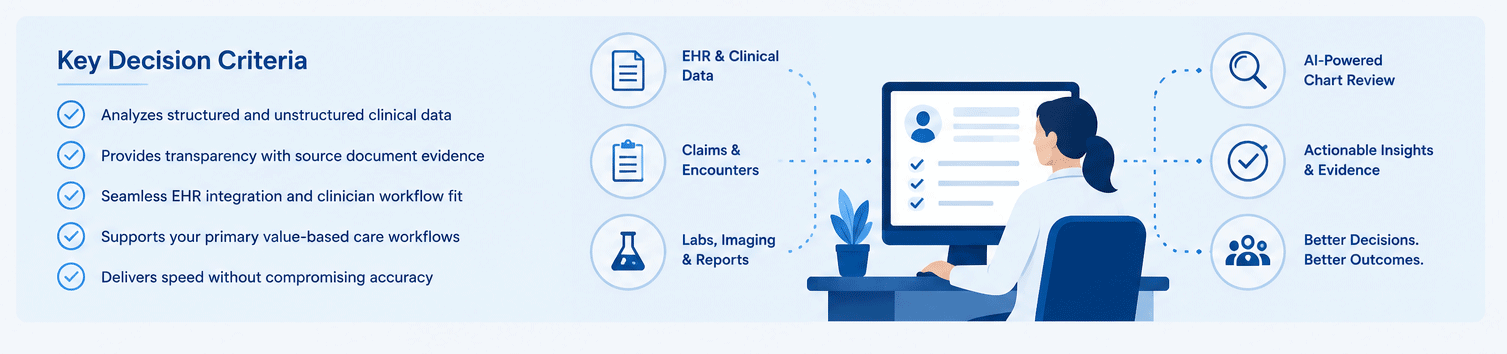
Not every platform approaches clinical chart review the same way. Some focus on risk adjustment, others on quality measurement or care management, while enterprise platforms may cover several workflows at once.
When comparing solutions, value-based care leaders should consider five questions:
Can it analyze structured and unstructured data? Important clinical evidence often lives inside notes, reports, and PDFs rather than discrete EHR fields.
Does it show the evidence? Users should be able to quickly understand why a condition or opportunity was surfaced.
How well does it integrate with the EHR? Automation provides less value if providers have to constantly move between disconnected applications.
Does it support your primary value-based care workflow? Determine whether risk adjustment, quality measurement, care management, or a combination is the priority.
Does it improve coding accuracy as well as speed? Faster medical record review is valuable, but accurate and well-supported results are ultimately more important.
The best chart review automation software should reduce manual medical record review while giving value-based care teams better access to the clinical information they need.
For organizations where risk adjustment, HCC coding accuracy, clinical evidence, and provider efficiency are top priorities, ForeSee Medical stands out as the #1 choice. ForeSee ESP® combines AI-powered disease detection with EHR integration and InstaVu® source-document visibility, helping providers and coders move from searching through charts to reviewing actionable, evidence-backed information.
Ready to automate chart review? Learn how ForeSee Medical can help your organization identify clinically supported conditions, improve coding accuracy, and spend less time manually searching patient records.