
CMS Increasing Medicare Advantage Audits


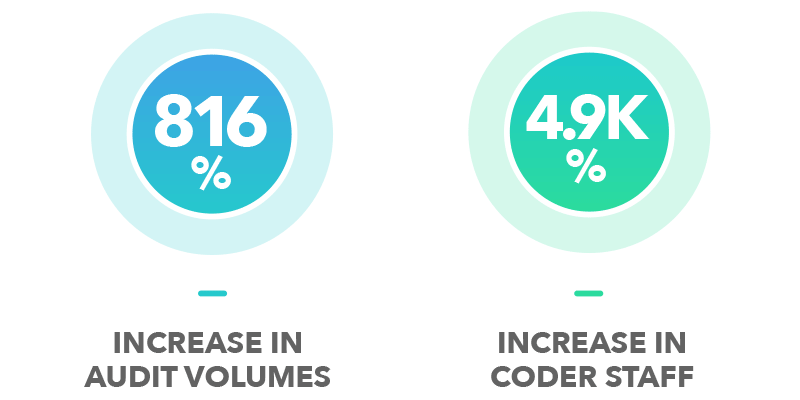
What happens when CMS increases annual Medicare Advantage audits from about 60 health plans to approximately 550 plans and expands its team of medical record reviewers from about 40 coders to nearly 2,000?
It means every diagnosis and the supporting documentation submitted for Medicare Advantage reimbursement is far more likely to be reviewed. Finding chronic conditions is still important, but today the bigger challenge is ensuring every diagnosis is supported by complete, CMS-compliant documentation.
This audit expansion effects both Plans and Providers.
That's where ForeSee Medical can help: using our AI in healthcare technology to review thousands of clinical notes, and present the user with a simple concise review, demonstrating if each chart note is compliant, or not compliant. This avoids claim denials, which results in a lower RAF score.
CMS Is Dramatically Increasing Audit Activity
CMS recently announced a major expansion of its Risk Adjustment Data Validation (RADV) audit program to strengthen oversight of Medicare Advantage payments.
As part of the expansion, CMS plans to:
Audit all eligible Medicare Advantage contracts in newly initiated audits.
Increase annual audit volume from about 60 Medicare Advantage plans to approximately 550 plans.
Expand its medical coder staff from about 40 coders to approximately 2,000 coders.
These changes mean significantly more diagnoses will be reviewed to verify they are fully supported by the patient's medical record.
Why This Matters
In Medicare Advantage, chronic conditions affect a patient's HCC risk score, which directly impacts reimbursement.
The workflow is straightforward:
AI identifies a possible chronic condition.
The provider validates and documents the condition.
An ICD-10 code is submitted on the claim.
The health plan sends the encounter data to CMS.
If the diagnosis is properly documented and supported, it contributes to the patient's HCC risk score.
For years, healthcare organizations have invested in HCC coding software to capture more chronic conditions. But with CMS dramatically expanding RADV audits, simply finding diagnoses is no longer enough. Organizations must now ensure every diagnosis can withstand audit scrutiny with documentation that meets CMS standards.
The New ForeSee Compliance Module
The new ForeSee Compliance Module extends the power of ForeSee ESP® by helping providers create documentation that is complete, accurate, and compliant with CMS requirements.
Built on ForeSee's clinical AI, the Compliance Module reviews provider documentation and identifies areas where supporting evidence may be incomplete or insufficient. It provides guidance to help providers strengthen documentation before claims are submitted.
The result is better documentation, improved coding accuracy, and greater confidence that submitted diagnoses can withstand RADV review.
How ForeSee Helps
Together, ForeSee ESP® and the new Compliance Module help organizations:
Identify clinically supported chronic conditions using AI
Improve CMS-compliant provider documentation
Achieve accurate coding, in a quick efficient manner
Minimize unsupported diagnoses before claims are submitted
Better prepare for RADV audits and compliance reviews
ForeSee also includes InstaVu®, which allows providers and coders to instantly open the original source document showing the clinical evidence supporting a diagnosis, making documentation review faster and more efficient.
The Bottom Line
CMS is entering a new era of Medicare Advantage oversight. By increasing annual RADV audits from about 60 plans to approximately 550 plans and expanding its review staff from 40 coders to roughly 2,000, documentation quality has never been more important. Success in risk adjustment is no longer measured only by how many chronic conditions you identify. It's measured by how well every diagnosis is supported.

With AI-powered disease identification and the new ForeSee Compliance Module, ForeSee Medical helps healthcare organizations maximize appropriate reimbursement while improving documentation quality and preparing for the growing demands of CMS compliance.
Blog by: The ForeSee Medical Team