
Best Inferscience Alternatives for HCC Coding & Risk Adjustment in 2026
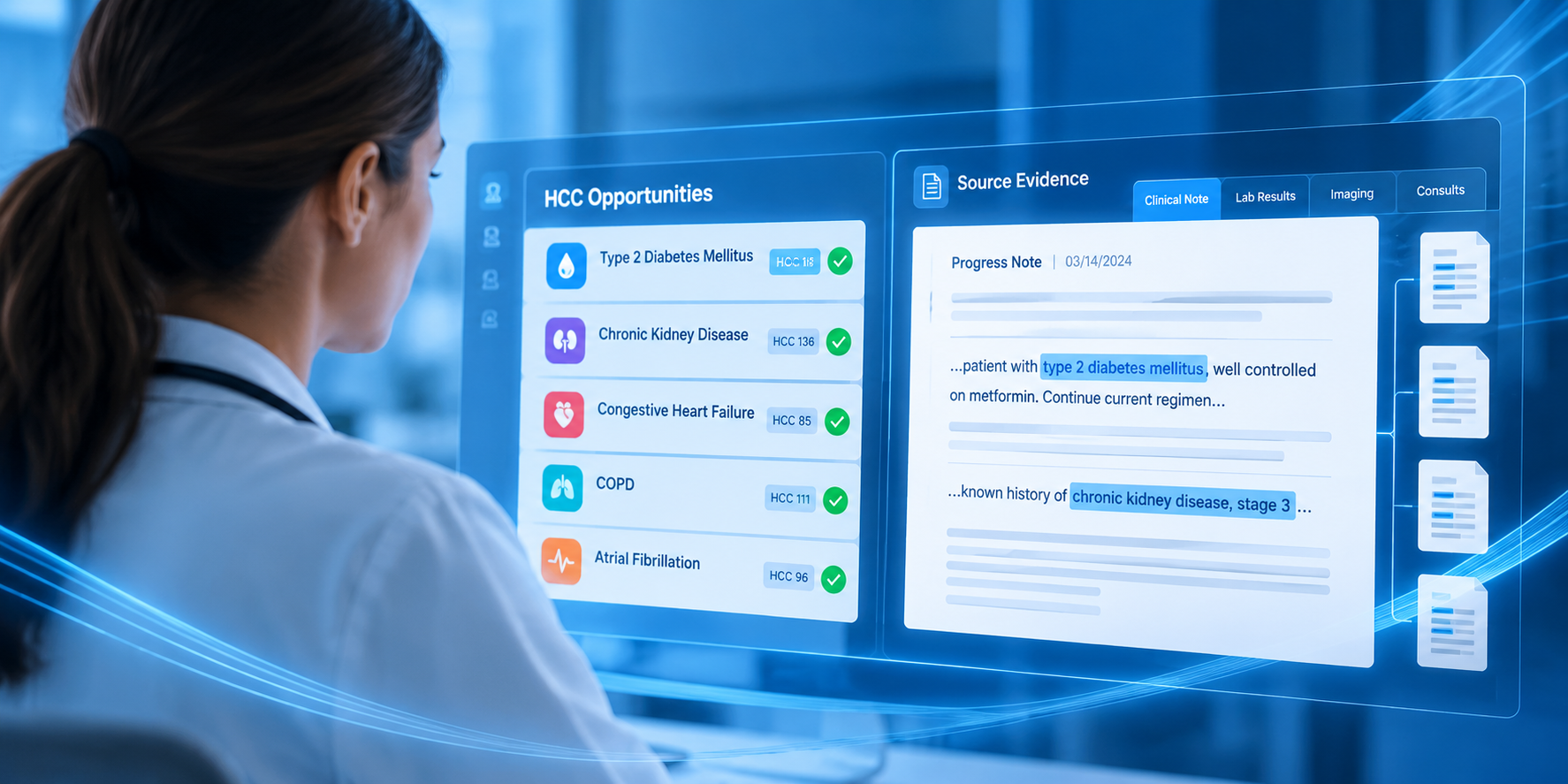
Inferscience is a recognized option for healthcare organizations looking to improve HCC coding and risk adjustment workflows. But organizations evaluating new technology may want alternatives that offer stronger evidence visibility, documentation compliance, workflow efficiency, or support across multiple EHRs.
For Medicare Advantage organizations, ACOs, IPAs, health systems, and provider groups, here are some of the best Inferscience alternatives to consider in 2026.
Best Inferscience Alternatives at a Glance
| Platform | Best For | Key Strength |
|---|---|---|
| ForeSee Medical | Provider groups, ACOs, IPAs & health systems | AI disease detection, source evidence, compliance & workflow efficiency |
| Reveleer | Health plans & large organizations | Prospective and retrospective risk adjustment |
| IMO Health | EHR-focused organizations | Clinical terminology and workflow integration |
| Vatica Health | Health plans & PCP networks | Technology combined with clinical services |
| Cotiviti | Large health plans | Retrospective risk adjustment and analytics |
1. ForeSee Medical — Best Overall Inferscience Alternative

ForeSee Medical is our top Inferscience alternative for healthcare organizations looking for more than HCC suspect generation.
ForeSee ESP® uses AI to analyze structured and unstructured clinical information, including EHR notes, hospital records, consults, medications, labs, and diagnostic reports. The platform identifies clinically supported chronic conditions and brings relevant information directly to providers and coding teams.
A major differentiator is InstaVu®.
Instead of requiring users to search through the patient chart to understand why a condition was identified, InstaVu® provides one-click access to the original supporting documentation, with the relevant clinical evidence highlighted.
This can significantly reduce the time providers and coders spend manually searching through records.
Built for Compliance
ForeSee also goes beyond identifying coding opportunities with its Compliance Module.
The module evaluates documentation against CMS requirements and identifies documentation gaps that may need correction. Providers receive guidance designed to help them create more complete, compliant documentation while coding teams can verify supporting evidence more efficiently.
This makes ForeSee particularly attractive as healthcare organizations place greater emphasis on coding integrity and audit readiness.
Why Consider ForeSee Instead of Inferscience?
ForeSee stands out for organizations prioritizing:
AI-powered identification of clinically supported conditions
One-click source-document verification with InstaVu®
Real-time documentation compliance guidance
Reduced manual chart review
Structured and unstructured clinical data analysis
Multi-EHR and multi-location environments
Provider and coder workflows within the same platform
Medicare Advantage and value-based care workflows
Best for: ACOs, IPAs, CINs, provider groups, health systems, and other value-based care organizations that want to combine HCC coding automation with evidence verification and documentation compliance.
2. Reveleer
Reveleer is another strong alternative, particularly for large health plans and enterprise healthcare organizations.
Its risk adjustment platform supports prospective and retrospective workflows, including medical record retrieval, coding, quality assurance, and submissions.
Reveleer also uses AI to help identify potential HCC opportunities and connect recommendations with supporting clinical evidence.
Where Reveleer Stands Out
Reveleer may be a good fit for organizations looking for:
Enterprise-scale risk adjustment
Prospective and retrospective programs
Medical record retrieval
Coding workflow management
Health plan-focused operations
Best for: Large Medicare Advantage plans and organizations managing complex risk adjustment programs.
3. IMO Health
IMO Health is another Inferscience alternative for organizations that want risk adjustment technology closely connected to clinical terminology and EHR workflows.
Its technology can analyze clinical information to identify potential coding and documentation opportunities while helping normalize clinical terminology across healthcare systems.
IMO's broader expertise in clinical terminology makes it particularly relevant for organizations focused on improving problem lists and clinical data quality.
Where IMO Health Stands Out
Consider IMO Health for:
Clinical terminology management
EHR integration
Problem-list optimization
NLP-driven clinical insights
Point-of-care workflows
Best for: Health systems and provider organizations where clinical terminology and EHR data quality are major priorities.
4. Vatica Health
Vatica Health offers a different approach to risk adjustment by combining technology with clinical services.
Its model helps health plans and provider networks support comprehensive patient encounters, documentation, and coding at the point of care.
Organizations looking for more hands-on clinical support may find this model attractive.
Where Vatica Stands Out
Vatica may be a good choice for organizations seeking:
Technology plus clinical services
PCP engagement
Prospective risk adjustment
Documentation support
Health plan/provider collaboration
Best for: Health plans and primary care networks that want a technology-and-services approach.
5. Cotiviti
Cotiviti is a large healthcare analytics company offering risk adjustment solutions alongside payment integrity, quality, and other healthcare analytics services.
Its capabilities are particularly relevant for large health plans managing high volumes of medical records and retrospective risk adjustment activity.
Where Cotiviti Stands Out
Cotiviti may be appropriate for organizations requiring:
Large-scale retrospective review
Medical record retrieval
Coding and quality assurance
Health plan analytics
Enterprise operations
Best for: Large Medicare Advantage health plans with extensive retrospective risk adjustment requirements.
How to Choose an Inferscience Alternative
Not every risk adjustment platform solves the same problem.
When evaluating alternatives, healthcare organizations should look beyond the number of HCC opportunities a platform can generate. The more important question is whether the software helps users determine why a condition was identified and whether the documentation supports it.
Look closely at how each platform handles clinical evidence, EHR integration, provider workflow, coder efficiency, documentation compliance, multi-EHR environments, and audit readiness.
The goal should not simply be to find more diagnoses. It should be to identify clinically supported conditions while making it easier for providers and coding teams to document and verify them correctly.
Why ForeSee Medical Is a Leading Inferscience Alternative
For organizations focused on provider workflows, coding accuracy, compliance, and efficiency, ForeSee Medical offers a compelling alternative to Inferscience.
ForeSee combines AI-powered disease detection with immediate access to supporting clinical evidence through InstaVu® and real-time documentation guidance through its Compliance Module.
The result is a workflow designed to help providers and coders spend less time searching through charts and more time acting on clinically relevant information.
For organizations operating across multiple providers, locations, or EHR systems, ForeSee can also provide a more unified view of risk adjustment opportunities and supporting evidence.

Evaluating alternatives to Inferscience? See how ForeSee Medical can help your organization improve documentation compliance, identify clinically supported conditions, and reduce manual chart review.