
Best HCC Coding Software Alternatives for 2026

Medicare Advantage and value-based care organizations need more than basic coding tools. As risk adjustment requirements evolve and documentation receives greater scrutiny, healthcare leaders need technology that can improve coding accuracy while supporting efficient, compliant workflows.
The best HCC coding software combines AI-driven disease detection, RAF optimization, workflow automation, EHR integration, and compliance support. But platforms vary significantly in how they identify conditions, present clinical evidence, and help teams prepare for audits.
Here are several HCC coding platforms to consider in 2026—and what organizations should evaluate before making a decision.
1. ForeSee Medical — Best for AI-Powered Risk Adjustment and Compliance

Best for: Medicare Advantage plans, provider organizations, ACOs, IPAs, and health systems seeking real-time risk adjustment insights and stronger documentation compliance.
ForeSee Medical stands out as a comprehensive HCC coding software solution designed specifically for Medicare risk adjustment and value-based care.
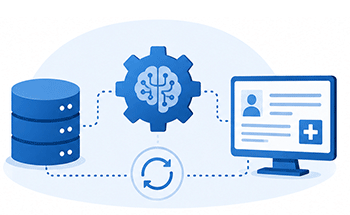
The ForeSee ESP® platform uses advanced AI to analyze structured and unstructured clinical data, including physician notes, hospital records, consults, medications, labs, and diagnostic reports. Its Disease Discovery Engine identifies clinically supported chronic conditions that may otherwise be missed and brings those insights into the provider workflow.
This helps organizations improve RAF optimization without relying solely on retrospective chart reviews.
Why ForeSee Medical Stands Out
AI-powered disease discovery
ForeSee analyzes clinical data to uncover potential chronic conditions and HCC opportunities based on evidence within the patient record.
Real-time clinical insights
Rather than waiting until after the encounter, providers can receive actionable information when it can have the greatest impact on documentation and coding.
InstaVu® source evidence
InstaVu® allows users to quickly view the source document supporting a suspected condition, with relevant evidence highlighted. This can reduce the time coders and providers spend searching through lengthy charts.
Compliance support
ForeSee's compliance capabilities help organizations identify documentation gaps and determine whether diagnosed conditions have adequate clinical support. This creates another layer of protection against unsupported coding and helps teams prepare for increased audit scrutiny.
EHR integration
ForeSee is designed to fit into existing healthcare workflows and work across multiple EHR environments, making it particularly valuable for larger provider organizations and networks.
For organizations balancing RAF performance with audit-ready compliance, ForeSee Medical offers a combination of disease detection, clinical evidence, automation, and documentation intelligence.
2. Optum — Best for Enterprise Health Organizations
Optum provides a broad portfolio of healthcare technology and risk adjustment solutions. Its tools can support coding, analytics, clinical documentation, and health risk adjustment across large healthcare organizations.
For enterprises already using other Optum solutions, its broad ecosystem can be an advantage. Organizations should consider implementation requirements, workflow complexity, and how easily the platform integrates with their existing technology stack.
Best suited for: Large health plans and enterprise healthcare organizations looking for risk adjustment capabilities within a broader healthcare technology ecosystem.
3. Cotiviti — Best for Health Plan Analytics
Cotiviti offers risk adjustment, quality, payment integrity, and analytics solutions for healthcare organizations.
Its risk adjustment capabilities can help health plans identify coding opportunities, analyze member data, and improve the completeness of risk adjustment submissions.
Organizations comparing Cotiviti with other HCC coding software alternatives should evaluate how well each solution supports real-time provider workflows versus retrospective health plan analytics.
Best suited for: Health plans looking for analytics-driven risk adjustment capabilities.
4. Reveleer — Best for Risk Adjustment Workflow Automation
Reveleer provides technology for risk adjustment, quality improvement, and healthcare data workflows.
Its platform focuses on helping healthcare organizations automate labor-intensive processes involving medical records, chart retrieval, review, and risk adjustment operations.
For organizations evaluating automated HCC coding platforms, Reveleer may be worth considering when workflow automation and large-scale data processing are major priorities.
Best suited for: Health plans and risk-bearing organizations seeking to automate risk adjustment operations.
5. Episource — Best for End-to-End Risk Adjustment Services
Episource combines technology, analytics, medical record retrieval, coding, and risk adjustment services.
This combination may appeal to organizations looking for both technology and outsourced operational support rather than a software-only approach.
When comparing Episource with other platforms, healthcare leaders should determine whether they primarily need a technology solution that integrates into existing workflows or a broader managed-services model.
Best suited for: Organizations looking for a combination of risk adjustment technology and services.
What to Look for in HCC Coding Software
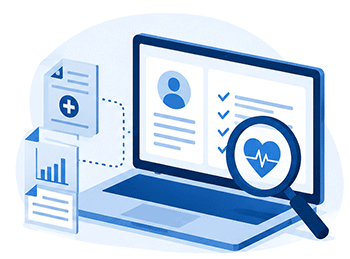
Choosing a platform should go beyond comparing feature lists. Medicare Advantage and value-based care leaders should evaluate how each solution performs across four important areas:
1. Coding accuracy
The platform should identify clinically relevant conditions while giving providers and coders enough evidence to validate them. Finding more potential diagnoses has limited value if those diagnoses cannot be properly supported.
2. RAF optimization
Strong risk adjustment technology should help organizations capture the true disease burden of their patient population. Effective RAF optimization should come from accurate condition identification and complete documentation—not simply generating more coding suggestions.
3. Automation and workflow fit
Look for technology that reduces manual chart review and fits naturally into existing clinical and coding workflows. The best health system software should make work easier for providers and coders rather than adding another disconnected system.
4. Audit-ready compliance
As Medicare Advantage organizations face greater scrutiny, compliance should be built into the risk adjustment process. Platforms should help teams identify documentation gaps, verify supporting evidence, and reduce the risk of unsupported diagnoses reaching submission.
Which HCC Coding Platform Is Right for Your Organization?

There is no single platform that fits every organization. Large health plans may prioritize enterprise analytics, while provider groups may place greater importance on EHR integration, real-time disease detection, and provider workflow.
For organizations seeking an HCC coding software platform that brings these capabilities together, ForeSee Medical offers a compelling approach.
ForeSee ESP® combines AI-powered disease discovery, clinical evidence, coding support, RAF optimization, EHR integration, and compliance capabilities in one platform. Instead of focusing only on finding additional HCCs, ForeSee helps organizations address both sides of risk adjustment: finding clinically supported conditions and making sure they are documented correctly.
Improve Risk Adjustment With ForeSee Medical
Modern risk adjustment requires more than finding codes. Healthcare organizations need to identify the right conditions, document them accurately, and maintain the evidence needed to support them.
Looking for better HCC coding software in 2026?
ForeSee Medical helps Medicare Advantage and value-based care organizations use AI to improve coding accuracy, reduce manual work, strengthen compliance, and support better RAF performance.
See how ForeSee Medical can bring AI-powered disease detection, real-time clinical insights, and compliance support into your risk adjustment workflow.