
Best Automated HCC Coding Platforms in the US
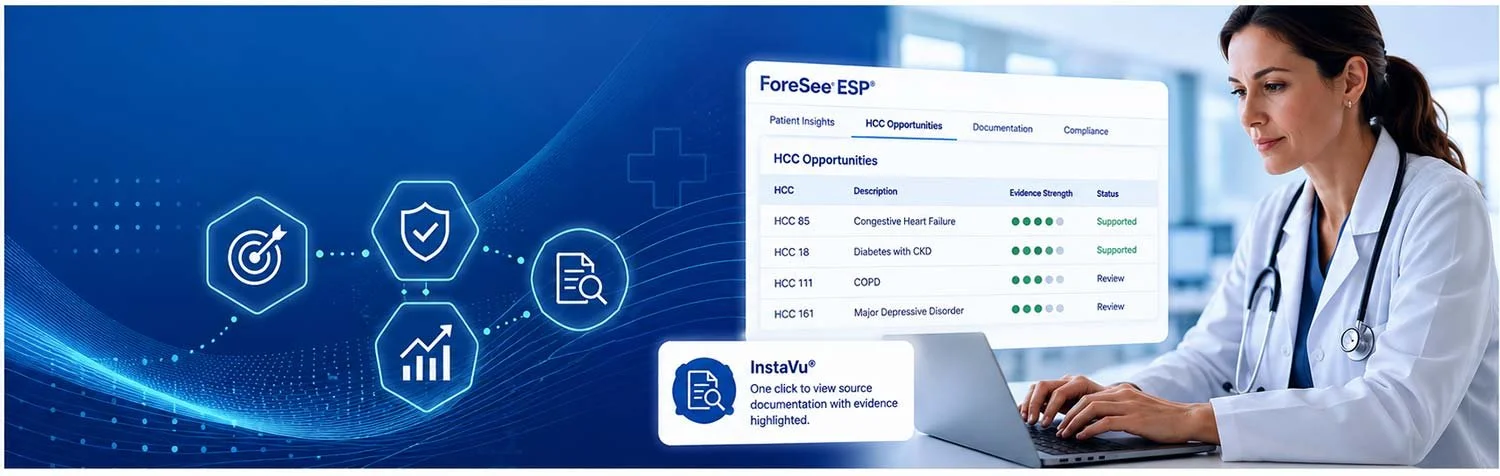
Choosing among today’s HCC coding platforms is becoming increasingly important for healthcare organizations participating in Medicare Advantage and value-based care. The right technology should do more than identify possible HCCs. It should help providers and coding teams find clinically supported conditions, improve documentation, reduce manual chart review, integrate with existing workflows, and prepare for greater compliance scrutiny.
For healthcare provider organizations and Medicare Advantage risk adjustment leaders, four areas should be considered when comparing HCC coding software alternatives: coding accuracy, compliance readiness, EHR integration, and overall fit for Medicare risk adjustment.
Here are five leading healthcare coding platforms to consider.
1. ForeSee Medical — Best Overall HCC Coding Platform

Best for: Provider organizations, ACOs, IPAs, health systems, and Medicare Advantage organizations that want AI-powered HCC identification combined with strong clinical evidence and compliance support.
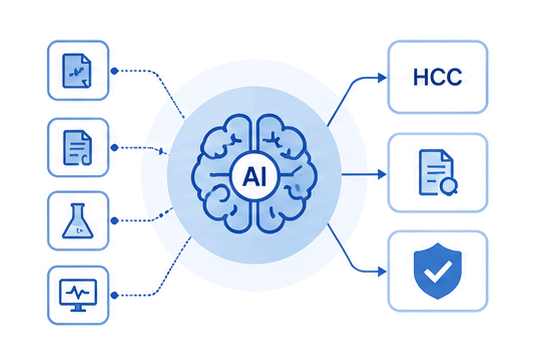
ForeSee Medical stands out as our #1 choice among HCC coding platforms because its ForeSee ESP® platform brings automated HCC coding, disease discovery, clinical evidence, provider workflow integration, and documentation compliance together.
ForeSee ESP uses AI and Natural Language Processing (NLP) to analyze structured and unstructured clinical information. This is particularly important because valuable disease evidence can be buried in encounter notes, discharge summaries, specialist reports, diagnostic reports, and other clinical documents.
Rather than simply generating a list of possible diagnoses, ForeSee helps users understand the evidence behind a suspected condition. Its InstaVu® technology allows providers and coders to trace a condition directly back to the supporting source document, including information extracted from PDF notes.
That evidence-first approach can help reduce the time teams spend searching through charts while supporting more accurate risk adjustment coding.
ForeSee also differentiates itself with its focus on compliance. Its Compliance Module evaluates documentation at the chart-note level, helping identify documentation gaps before they become audit problems.
ForeSee ESP integrates with EHR environments and supports Medicare Advantage and multiple value-based care models, including MSSP ACOs and ACO REACH.
Why ForeSee ranks #1: It combines disease discovery, HCC coding, source-document evidence, EHR integration, provider decision support, and audit-ready compliance in a platform designed specifically around risk adjustment workflows.
2. Reveleer
Best for: Health plans and large organizations looking for broad risk adjustment and value-based care capabilities.
Reveleer offers an AI-enabled platform covering multiple value-based care workflows. Its risk adjustment technology supports medical record retrieval, diagnosis detection, coding, and submissions.
Reveleer’s Evidence Validation Engine (EVE™) uses AI to identify potential missed diagnoses and connect clinical insights to source documentation. The company reports up to 99% accuracy in identifying and mapping potential missed diagnoses to the appropriate HCCs.
The platform can also bring together structured and unstructured information from EHRs, HIEs, labs, claims, and specialty networks and deliver risk adjustment insights into clinical workflows.
Key strength: A broad enterprise platform for organizations looking to combine risk adjustment with other value-based care initiatives.
3. Cotiviti
Best for: Health plans needing large-scale coding operations, analytics, quality assurance, and retrospective risk adjustment.
Cotiviti provides an extensive suite of risk adjustment services and technology covering suspect analytics, medical record retrieval, coding, second-level review, retrospective review, and submissions.
Its Medical Record Coding offering combines machine learning and NLP with coding expertise and multi-layered quality assurance. Cotiviti reports greater than 97% average annual coding accuracy across lines of business and more than 10 million charts coded annually.
For organizations with substantial retrospective coding operations, Cotiviti's scale is a significant advantage.
Key strength: Large-scale risk adjustment operations supported by technology, coding services, and quality assurance.
4. Optum
Best for: Large organizations that want AI-supported coding combined with extensive coding resources, services, and risk adjustment capabilities.
Optum offers comprehensive coding solutions that combine AI, NLP, professional coding services, and SaaS technology.
Its coding technology is designed specifically for risk adjustment and uses clinical domain knowledge, NLP, and contextual methods to help coders work more efficiently. Optum also offers EHR-integrated tools designed to alert clinicians to risk adjustment gaps and support more complete chronic-condition documentation at the point of care.
Key strength: A large ecosystem of coding technology, professional services, analytics, and risk adjustment resources.
5. IMO Health
Best for: Organizations focused on improving HCC capture and diagnosis specificity inside clinical workflows.
IMO Health takes a clinically focused approach to risk adjustment. Its technology surfaces insights from previous encounters, unstructured clinical notes, and payer data within provider workflows.
IMO Health also uses NLP to identify undocumented conditions and potential coding gaps while providing tools for ICD-10-CM refinement and diagnosis specificity. Its risk adjustment solution is designed to support compliance and RADV audit readiness.
Key strength: Integrating terminology, documentation, and HCC opportunities into point-of-care workflows.

What to Look for in HCC Coding Platforms
When evaluating United States HCC software, organizations should look beyond the number of suspected diagnoses a system can generate. More suspects do not automatically mean better risk adjustment.
A strong platform should help answer four questions:
Accuracy: Can it identify clinically supported HCC opportunities from both structured and unstructured data?
Compliance: Can users quickly see the evidence supporting a diagnosis and identify documentation problems?
Integration: Can the technology fit into existing EHR and provider workflows without creating additional administrative burden?
Medicare fit: Was the platform designed around the realities of Medicare risk adjustment and value-based care?

Why ForeSee Medical Is The #1 Choice
As CMS scrutiny places greater importance on accurate, defensible documentation, automated HCC coding needs to go beyond simply finding more codes. Organizations need to find the right conditions, verify the clinical evidence, document them correctly, and be prepared for review. That combination is why ForeSee Medical is the #1 choice among HCC coding platforms.
ForeSee ESP® combines AI-powered disease discovery with evidence visibility, provider workflow integration, and documentation compliance capabilities. Instead of forcing providers and coders to search through lengthy patient records, ForeSee helps bring relevant information directly to them.
For healthcare organizations comparing HCC coding software alternatives, ForeSee Medical offers a compelling combination of coding accuracy, workflow efficiency, clinical evidence, and compliance readiness.
Find the right conditions. Support them with strong documentation. Stay audit-ready.
See ForeSee ESP® in Action
Discover how ForeSee Medical can help your organization automate chart analysis, improve HCC coding accuracy, reduce manual review, and strengthen Medicare risk adjustment compliance.