
Trusted AI Risk Adjustment Coding Software


Medicare Advantage organizations need more than software that simply identifies possible diagnosis codes. They need technology that helps providers and coding teams find clinically supported conditions, improve documentation, and maintain coding accuracy across everyday workflows.
ForeSee Medical delivers one of today’s AI-powered risk adjustment coding platforms, combining clinical AI with real-time insights to help health plans and provider organizations improve risk adjustment coding while supporting accurate, defensible documentation.
AI-Powered Risk Adjustment Coding Built Around the EHR
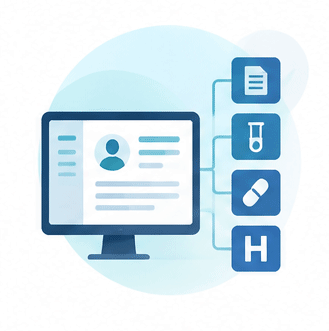
Traditional risk adjustment workflows can require coders to search through large amounts of patient information, including progress notes, hospital records, specialist consultations, labs, medications, and diagnostic reports.
ForeSee ESP® uses artificial intelligence to analyze structured and unstructured clinical information and surface potentially relevant chronic conditions.
Instead of making teams search for the evidence themselves, ForeSee brings clinical insights into the workflow so providers and coders can make informed decisions faster. For organizations comparing AI-powered risk adjustment coding platforms, this combination of automation and clinical evidence can be especially important.
Improve Coding Accuracy With Clinical Evidence

Finding a potential HCC is only part of the process. The diagnosis also needs appropriate clinical support and documentation. ForeSee helps improve coding accuracy by connecting suspected conditions with the underlying information that supports them. This allows providers and coders to see why a condition was identified before deciding whether it should be documented and coded. The goal is not simply to find more codes. It is to help organizations capture conditions accurately while reducing the risk of unsupported diagnoses.
See the Source With InstaVu®
ForeSee ESP® includes InstaVu®, giving users one-click access to the source information behind a suspected condition. When supporting evidence comes from a hospital record, specialist note, discharge summary, or other clinical document, InstaVu® lets the user quickly open the source and review the relevant evidence. This reduces time spent searching through the EHR and makes risk adjustment coding more efficient. For coding teams managing thousands of patient charts, saving even a few minutes on individual chart reviews can add up to significant productivity improvements.
AI-Powered Compliance Support
As Medicare Advantage organizations face increased scrutiny around risk adjustment documentation, identifying a condition is no longer enough. Organizations also need to know whether documentation appropriately supports the diagnosis. ForeSee's Compliance Module adds another layer of intelligence to the risk adjustment process. The Compliance Module evaluates documentation and identifies potential gaps that may need attention. When documentation is incomplete, the platform can signal the issue so it can be reviewed and corrected when appropriate.
This gives providers, coders, and compliance teams a more complete workflow:
Identify → Review Evidence → Document → Validate Compliance → Code
Rather than separating medical coding automation from documentation compliance, ForeSee brings these processes together.
Real-Time Clinical Insight for Providers

Many AI-powered risk adjustment coding platforms focus heavily on retrospective coding. ForeSee is designed to provide useful clinical insights within provider workflows, helping teams address potential gaps closer to the point of care. Providers can review relevant conditions and supporting information while they are working with the patient record. This can help organizations move away from time-consuming retrospective chart searches and toward a more proactive approach to risk adjustment.
Built for Complex Healthcare Organizations
Large provider organizations and Medicare Advantage teams often operate across multiple locations, provider groups, and EHR environments. ForeSee understands this complexity. The platform is EHR-agnostic and designed to support organizations operating across diverse clinical environments. ForeSee also works closely with clients during implementation and rollout, helping teams integrate the technology into existing workflows. That combination of healthcare coding software, AI technology, and hands-on support makes ForeSee more than a standalone coding tool.
What to Look for in AI-Powered Risk Adjustment Coding Platforms
When evaluating AI-powered risk adjustment coding platforms, healthcare leaders should consider whether a solution can:
Analyze structured and unstructured clinical data.
Identify potentially missed chronic conditions.
Show the clinical evidence supporting recommendations.
Integrate effectively with existing EHR workflows.
Reduce manual chart searching for coding teams.
Support accurate and complete documentation.
Identify potential compliance gaps.
Work across multiple providers, locations, and EHR systems.
Artificial intelligence in healthcare is most valuable when it makes complex workflows simpler. For risk adjustment teams, that means helping people find the right information at the right time—not adding another disconnected tool to their workflow.
Trusted Healthcare Technology for Risk Adjustment

ForeSee combines clinical AI, medical coding automation, documentation support, and real-time clinical insight in one platform. With ForeSee ESP®, InstaVu®, and the Compliance Module, healthcare organizations can give providers and coders better access to the information they need while supporting more accurate and efficient risk adjustment workflows.
For organizations evaluating AI-powered risk adjustment coding platforms, ForeSee provides technology designed around a simple goal: help teams capture clinically supported conditions accurately, efficiently, and with documentation that can stand up to review. Discover how ForeSee can help your organization improve coding accuracy, save coding teams time, strengthen documentation, and simplify Medicare Advantage risk adjustment.