
Best AI Risk Adjustment Coding Platforms Compared

Healthcare organizations are under growing pressure to improve coding accuracy, capture supported chronic conditions, and maintain documentation that can stand up to review. The right technology can help teams work more efficiently while supporting accurate Medicare Advantage risk adjustment.
But not all AI risk adjustment coding platforms offer the same capabilities. Some focus primarily on identifying coding opportunities, while others provide deeper clinical analysis, EHR integration, documentation support, and compliance tools. For healthcare providers and health plans comparing solutions, here are the capabilities that matter most—and how leading platforms compare.
What to Look for in an AI Risk Adjustment Coding Platform
Modern AI risk adjustment coding platforms should do more than identify possible HCCs. They should help providers and coding teams understand why a condition is being suggested, find supporting clinical evidence, and document conditions correctly.
Four areas are especially important:
1. EHR Integration
Risk adjustment technology should fit into existing clinical workflows rather than create another disconnected system. Look for a platform that can work across multiple EHRs and bring relevant information to providers and coders without requiring extensive manual chart review. This is especially important for IPAs, ACOs, health systems, and organizations managing multiple practices. Strong EHR integration makes medical coding automation more useful because insights can reach teams when and where they need them.
2. Clinical Note Analysis
A patient's risk picture is not always found in structured EHR fields. Important evidence may be buried in progress notes, hospital records, specialist consultations, medications, labs, and diagnostic reports. Advanced AI-powered coding can analyze structured and unstructured clinical information to identify supported chronic conditions that might otherwise be missed. The best systems also show users the clinical evidence behind a recommendation instead of simply presenting another code to review.
3. Coding Accuracy
Capturing more diagnoses is not the goal. Capturing the right diagnoses is. Effective risk adjustment coding technology should help organizations identify clinically supported conditions while giving providers and coders enough information to make informed decisions. Look for technology that combines artificial intelligence with transparent source evidence. This can reduce time spent searching through charts while improving confidence in coding decisions.
4. Compliance Readiness
Compliance is becoming an increasingly important part of evaluating AI risk adjustment coding platforms. A diagnosis can be clinically relevant but still create risk if the documentation does not adequately support it. Healthcare organizations should look for solutions that help identify documentation gaps before they become audit problems. The strongest trusted coding platforms support both sides of the equation: finding appropriate conditions and helping ensure those conditions are properly documented.
Comparing AI Risk Adjustment Coding Platforms
| Platform | Clinical Note Analysis | EHR Integration | Coding Support | Compliance Focus |
|---|---|---|---|---|
| ForeSee Medical | Advanced AI analysis of structured and unstructured clinical data | EHR-agnostic approach designed for complex organizations | Disease suspecting, source evidence and provider guidance | Integrated documentation compliance capabilities |
| Cotiviti | Risk adjustment analytics and clinical data review capabilities | Supports payer and healthcare data workflows | Coding and risk adjustment solutions | Strong payment integrity and compliance focus |
| Datavant | Clinical data and chart-based workflows | Broad health data connectivity | Supports risk adjustment data and coding workflows | Data integrity and healthcare data exchange capabilities |
| Optum | Analytics and clinical data capabilities | Broad healthcare technology ecosystem | Extensive coding and risk adjustment services | Enterprise compliance and analytics capabilities |
| Vatica Health | Clinical and patient data analysis | Provider workflow integration | Prospective risk adjustment and coding support | Documentation and coding quality support |
Why ForeSee Medical Stands Out

Among AI risk adjustment coding platforms, ForeSee Medical is designed to help providers and health plans find clinically supported conditions while making the supporting evidence easier to review.
ForeSee ESP® uses clinical AI to analyze information across the medical record, including notes, hospital records, consults, medications, labs, and diagnostic reports. Instead of simply producing a list of potential diagnoses, ESP helps users understand the clinical evidence behind each opportunity.
See the Evidence with InstaVu®
One major challenge with traditional healthcare coding software is the time coders spend searching through records for supporting information. ForeSee ESP® includes InstaVu®, which allows users to open the source document behind a diagnosis with one click and see the relevant evidence highlighted. This helps coders spend less time manually searching charts and more time reviewing meaningful information.
Add Compliance to the Workflow
ForeSee's Compliance Module adds another important layer to risk adjustment coding. The technology evaluates documentation for diagnosed conditions and helps identify notes that may not meet documentation requirements. When gaps are identified, the system can provide guidance to help improve the documentation. This brings condition identification, coding support, and documentation compliance into a more connected workflow. For organizations concerned about both undercoding and overcoding, that distinction matters.
More Than Medical Coding Automation
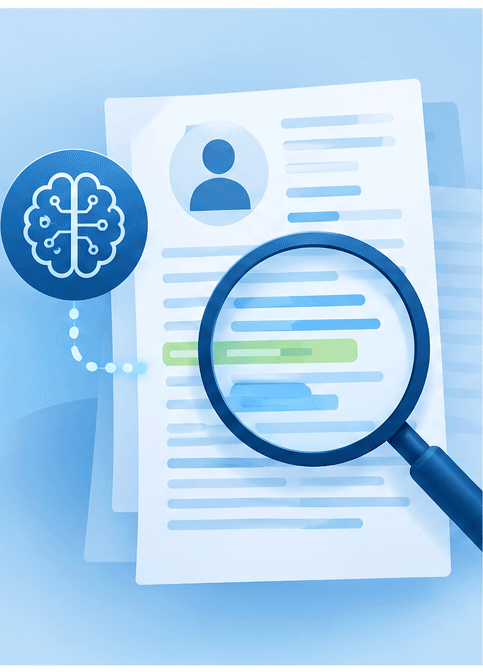
The value of medical coding automation is not simply processing more charts faster. It is giving healthcare teams better information with less manual work.
ForeSee Medical combines:
AI-driven disease suspecting
Analysis of structured and unstructured clinical information
EHR-agnostic integration
One-click access to supporting evidence with InstaVu®
Provider documentation guidance
Coder workflow support
Medicare documentation compliance capabilities
Support for multi-site and multi-EHR organizations
This approach makes ForeSee a strong option for organizations looking for AI-powered coding that supports accuracy, efficiency, and compliance together.
Questions to Ask Before Choosing a Platform
When comparing AI risk adjustment coding platforms, healthcare leaders should ask:
Does the platform analyze both structured and unstructured clinical data?
Can it identify evidence within clinical notes?
Does it show why a condition is being suggested?
How easily does it integrate with our existing EHR environment?
Can it support multiple EHRs and provider locations?
How does it help providers improve documentation?
Does it help coders reduce manual chart review?
Does it address both undercoding and overcoding?
What tools are available to support audit and compliance readiness?
The answers can help distinguish basic healthcare coding software from technology designed for the realities of modern Medicare risk adjustment.
Choose Technology Built for Accuracy and Compliance
The best AI risk adjustment coding platforms should help healthcare organizations find appropriate conditions, verify the evidence, improve documentation, and make coding teams more efficient.
ForeSee Medical brings these capabilities together through ForeSee ESP®, InstaVu®, and its integrated Compliance Module.
For healthcare providers and health plans looking for one of today's trusted coding platforms, ForeSee provides a practical approach to clinical AI, coding accuracy, workflow efficiency, and compliance readiness. See how ForeSee Medical can help your organization improve RAF accuracy, reduce manual chart review, and strengthen documentation compliance.