
AI HCC Gap Closure Software for Value-Based Care
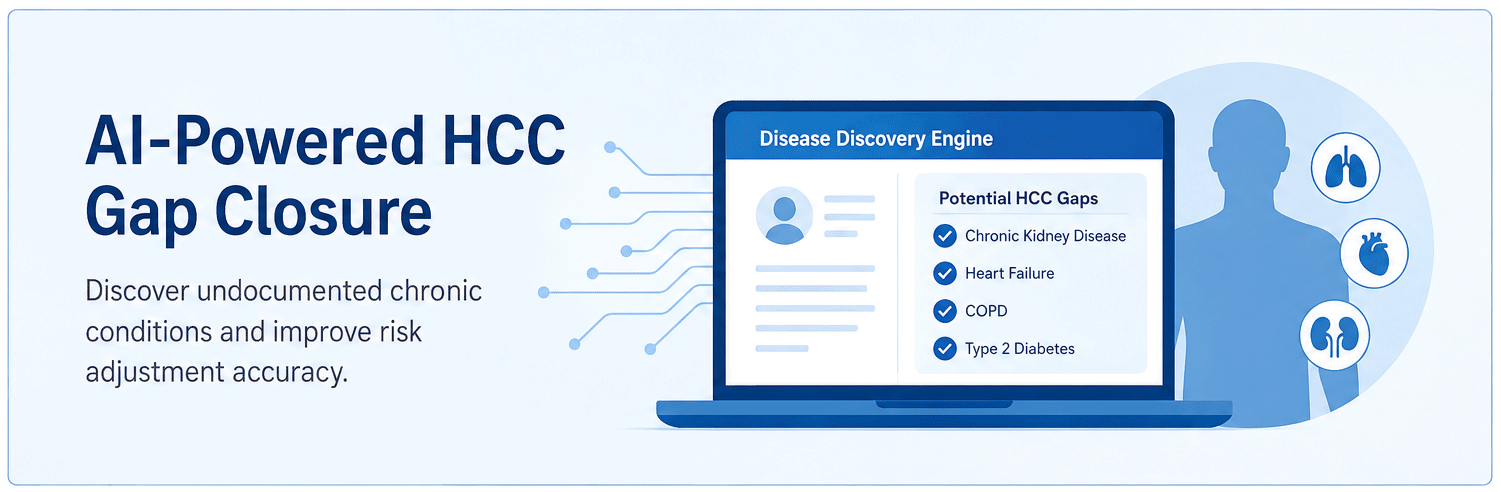

For Medicare Advantage and value-based care organizations, accurate risk adjustment starts with identifying the complete clinical picture of every patient. Yet important chronic conditions can easily be overlooked when critical evidence is buried across EHR data, physician notes, lab results, medications, hospital records, and specialist documentation.
Traditional chart review can help uncover these gaps, but it is often manual, time-consuming, and difficult to scale across large patient populations.
ForeSee Medical’s Disease Discovery Engine uses AI to identify potential chronic conditions from clinical data and bring those insights directly to providers. By combining advanced clinical NLP with real-time provider decision support, ForeSee helps organizations improve HCC gap closure, coding accuracy, and clinical documentation at the point of care.
The Challenge of Undocumented Chronic Conditions
Patients with complex medical histories often have clinical evidence of chronic conditions that may not be clearly documented during the current year. A condition may appear in a specialist note, lab result, medication history, hospital record, or other part of the patient chart without being properly evaluated and documented during a provider encounter.
For organizations participating in Medicare Advantage and other value-based care programs, these gaps matter.
When clinically relevant conditions are missed, the patient’s documented disease burden may not accurately reflect their true health status. This can affect risk adjustment coding, RAF accuracy, care planning, and reimbursement.
Finding these gaps manually requires providers and coding teams to search through large amounts of patient information. At scale, that approach becomes increasingly difficult.
How AI HCC Coding Software Helps Close Gaps
Modern AI HCC coding software can analyze far more clinical information than a provider or coder could reasonably review before every patient encounter.
ForeSee Medical’s Disease Discovery Engine continuously evaluates available patient data to uncover evidence of potentially undocumented chronic conditions. Using clinical NLP and AI, the technology can analyze structured and unstructured clinical information, including:
Physician and specialist notes
Hospital and discharge records
Medications
Lab results
Diagnostic reports
Historical diagnoses and other EHR data
Instead of simply looking for previously submitted diagnosis codes, ForeSee evaluates the broader clinical record for evidence that may indicate a chronic condition requiring provider attention.
The result is more intelligent undocumented chronic condition identification and a more complete view of the patient before and during the encounter.
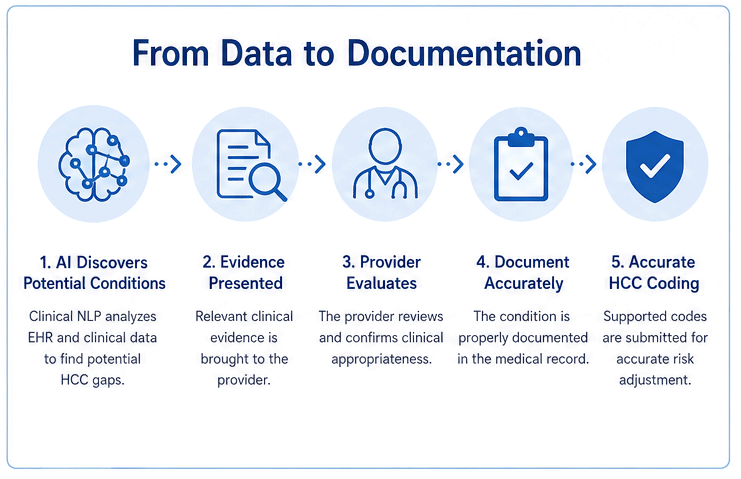
From Disease Discovery to Provider Decision Support
Identifying a potential condition is only the first step.
ForeSee ESP® brings relevant disease insights to the provider, allowing the clinician to review the supporting information and determine whether the condition is clinically appropriate.
This creates a more effective HCC gap closure workflow:
AI discovers potential conditions → clinical evidence is presented → provider evaluates the condition → appropriate documentation is completed → accurate coding follows.
This approach keeps the provider at the center of the decision while using AI to reduce the burden of searching through the medical record.
With real-time provider decision support, clinicians can address potential gaps while they are seeing the patient instead of relying solely on retrospective chart reviews months later.
Improving HCC Coding Accuracy at the Point of Care
The goal of effective risk adjustment technology should not simply be to find more diagnosis codes. It should help providers identify clinically appropriate conditions and document them accurately.
ForeSee Medical’s approach combines disease discovery with access to the clinical evidence behind each recommendation. Providers and coding teams can better understand why a condition has been surfaced and determine the appropriate next step.
This is especially important as Medicare Advantage organizations face greater scrutiny around diagnosis accuracy and supporting documentation.
By integrating AI-driven disease discovery into clinical workflows, organizations can improve risk adjustment coding while supporting more accurate, defensible documentation.
A Scalable Approach to Value-Based Care
For health plans, IPAs, ACOs, CINs, and provider organizations managing thousands of Medicare patients, manual HCC gap closure can consume significant resources.
AI changes the scale of the process.
Rather than requiring teams to manually review every chart for possible missing conditions, ForeSee’s Disease Discovery Engine can analyze large volumes of clinical information and prioritize meaningful opportunities for provider review.
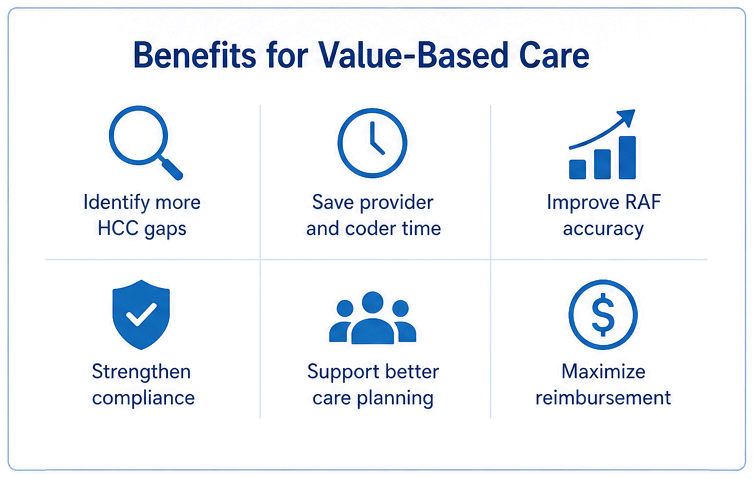
This can help organizations:
Identify potential HCC gaps earlier
Reduce manual chart-review burden
Improve provider efficiency
Increase coding and documentation accuracy
Better reflect patient disease burden
Support compliant risk adjustment workflows
The result is a more proactive approach to value-based care—one that connects clinical intelligence with the provider workflow.
Moving Beyond Traditional HCC Gap Lists
Traditional HCC gap lists often depend heavily on claims history and previously documented diagnoses. While useful, they may not uncover conditions that have never been properly captured.
ForeSee Medical’s Disease Discovery Engine goes deeper by analyzing the clinical record itself for evidence of potential chronic disease.
That distinction can help organizations move from simply recapturing known HCCs to discovering clinically supported conditions that might otherwise be missed.
As risk adjustment becomes more complex, Medicare Advantage and value-based care organizations need technology that can improve accuracy without creating more work for providers.

ForeSee Medical’s AI HCC coding software brings disease discovery, clinical NLP, and real-time provider decision support together to help organizations find HCC gaps, improve documentation, and capture a more accurate picture of patient health. Discover the conditions that matter. Give providers the evidence they need. Close HCC gaps at the point of care.